
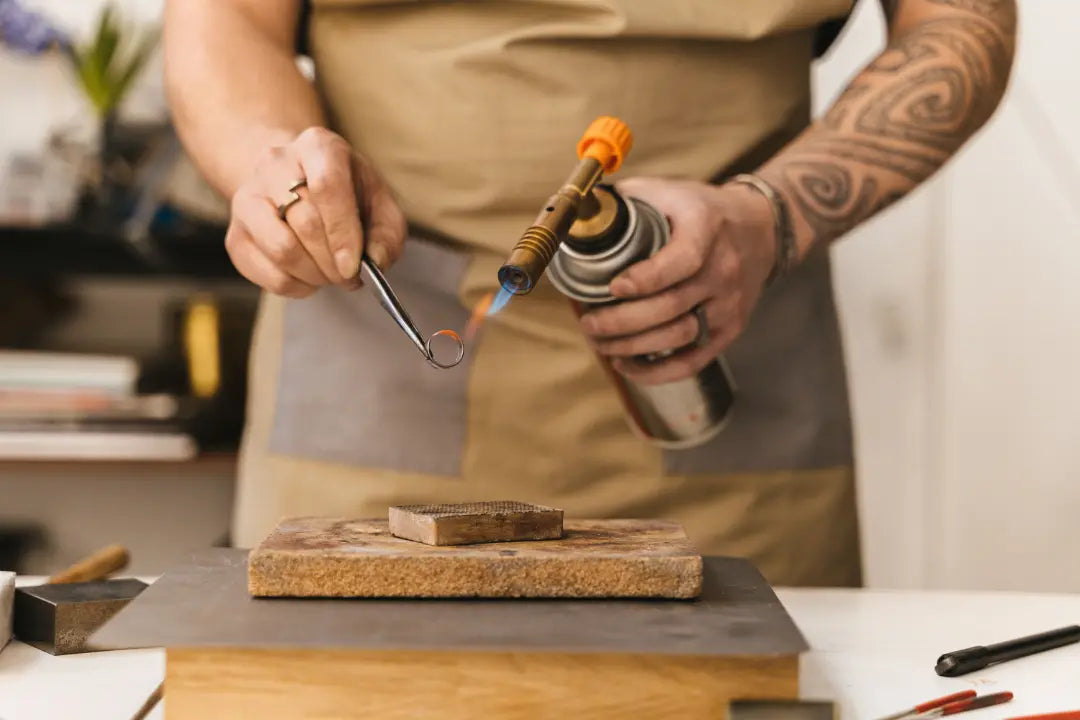
Lost-wax casting is an ancient and versatile technique used to create detailed metal jewelry and decorative objects. The process begins with a wax model, which is invested, burned out, and replaced with molten metal such as gold or silver. Each stage, from pattern preparation and temperature control to cooling, cleaning, and finishing, affects the final result.
Understanding lost-wax casting helps buyers appreciate the precision, skill, and craftsmanship required to produce fine jewelry with complex shapes, textures, and intricate decorative details.
What Is the Lost-Wax Casting Technique and How Does It Work?
Lost-wax casting, sometimes called investment casting, begins with a model that represents the exact form the artisan wants to reproduce in metal.
Traditionally, this model is made from wax. The wax pattern is surrounded by a heat-resistant investment material that hardens around it. Once the investment has set, the mold is heated. The wax melts and burns out, leaving an empty cavity in the shape of the original design. Molten metal is then introduced into this cavity.
After the metal cools and solidifies, the investment material is removed. The newly cast object can then be cleaned, cut from its casting channels, polished, assembled, textured, engraved, or otherwise finished. The word "lost" refers to the wax pattern being destroyed during burnout. Because the original pattern disappears, each directly sculpted wax model traditionally produces one cast version unless a reusable mold has first been made to reproduce multiple wax patterns.

How Is the Wax Pattern Created for Lost-Wax Casting?
The wax pattern is one of the most important parts of the entire process because it establishes the shape, dimensions, texture, and much of the detail that will appear in the finished metal object. Artisans can create wax patterns in several ways.
A jeweler may carve a design directly from a solid block of specialized carving wax. This approach provides substantial creative control and is particularly useful for custom work and sculptural designs. Another method involves injecting molten or softened wax into a reusable mold. This technique makes it possible to create multiple nearly identical wax patterns for jewelry produced in a series.
Modern jewelers may also begin with computer-aided design. A digital model can be produced through additive manufacturing before being incorporated into an investment-casting workflow. Although the design stage may be digital, careful preparation and casting control remain essential.
Importance of Precision in Wax Pattern Making
The casting process reproduces what is present in the pattern, including mistakes. If a wax model contains uneven surfaces, unwanted scratches, poor proportions, weak sections, or incorrect dimensions, those problems may appear in the metal casting as well. For that reason, artisans carefully inspect the pattern before moving forward.
Jewelry must also be designed with practical considerations in mind. Thin sections may be difficult to fill properly with molten metal. Heavy areas can behave differently as they cool. Clasps, stone settings, connection points, and decorative features all require careful planning. Precision at the pattern stage reduces the amount of corrective work required later and contributes to a cleaner finished piece.
How Are Sprues Added to Prepare the Wax Model for Casting?
Before investing the wax pattern, the artisan normally attaches one or more wax channels known as sprues. Sprues create pathways through which molten metal can enter the mold. They also help control the movement of metal and gases during casting.
The position and thickness of these channels require careful consideration. Poor sprue placement can contribute to incomplete filling, porosity, surface defects, or other casting problems.
For production jewelry, several wax patterns may be attached to a central wax stem. The resulting structure is commonly compared to a tree because multiple pieces branch outward from a central channel. Once the wax tree is complete, it is ready for investment.
What Happens During the Investment Stage of Lost-Wax Casting?
Investment is the stage in which the wax model becomes surrounded by heat-resistant mold material. The wax assembly is usually positioned inside a flask. A specially prepared investment mixture is then poured around it.
The investment must flow around fine details without trapping excessive air. Air bubbles positioned against the wax can create unwanted bumps or imperfections in the final casting. Professional workshops may therefore use vacuum equipment or controlled mixing procedures to reduce trapped air.
After pouring, the investment is allowed to harden. The result is a solid mold containing the wax pattern within it. At this stage, the mold still cannot receive molten metal. The wax first needs to be removed completely.
How Is Molten Metal Introduced Into the Investment Mold?
Once the wax has been removed and the mold has reached the appropriate casting condition, metal is melted and introduced into the cavity. Different workshops may use different casting systems.
Centrifugal casting uses rotational force to drive molten metal into the mold. Vacuum-assisted casting uses pressure differences to help draw metal through the cavity. Other professional equipment can also be used depending on the scale of production and type of jewelry being created. The metal must be handled at a suitable temperature for the alloy and design.
If conditions are incorrect, the metal may not completely fill small details. Excessive heat, contamination, unsuitable flask temperatures, or poor technique can also contribute to defects. Experienced casters therefore balance several variables at the same time rather than relying on a single fixed temperature or procedure for every piece.
What Happens After the Metal Has Been Cast?
Casting does not produce a finished piece of jewelry immediately. After the metal has solidified and cooled appropriately, the investment material must be removed. The rough casting is cleaned so that the artisan can inspect the surface and identify any areas requiring additional work.
Sprues are then cut away. The points where the sprues were attached must be filed and finished carefully so that they blend smoothly with the rest of the design. Depending on the jewelry, additional stages may include soldering, assembly, stone setting, engraving, texturing, polishing, plating, or applying a controlled surface finish.

Importance of Finishing in High-Quality Cast Jewelry
The quality of finishing can significantly change the appearance of the same basic casting. Rough surfaces, visible sprue marks, uneven polishing, poorly cleaned recesses, or careless solder joints can make an otherwise good design appear inexpensive. Skilled finishing involves removing unwanted casting marks without destroying the intentional details of the piece.
For highly textured jewelry, the artisan needs to preserve the contrast between raised and recessed areas. For polished jewelry, surfaces may require several stages of abrasion and polishing before achieving the desired finish. This is one reason buyers should assess craftsmanship across the entire piece instead of assuming that lost-wax casting itself guarantees quality.
What Makes Italian Lost-Wax Casting Distinctive?
Lost-wax casting is not exclusive to Italy. The method has been used by different cultures and metalworking traditions for thousands of years. What distinguishes Italian jewelry can be the way individual workshops combine casting with established traditions of design, metalworking, chain making, finishing, engraving, stone setting, and contemporary production.
Italian jewelry manufacturing includes both artisan workshops and sophisticated larger-scale producers. As a result, the phrase "Italian craftsmanship" can describe a wide range of manufacturing approaches. The most meaningful assessment is therefore based on the quality of a particular piece rather than nationality alone.
Traditional Skills and Modern Technology in Italian Jewelry Making
Modern production does not necessarily replace traditional craftsmanship. A contemporary Italian jeweler may use digital design to establish proportions, create a precise model using modern equipment, cast the piece through investment casting, and then finish it by hand. Another artisan may carve the entire original pattern manually.
Both approaches can produce exceptional results when they are executed well. Digital tools can improve repeatability and make complex geometries practical, while hand finishing allows artisans to refine surfaces and details that equipment alone may not complete to the desired standard.
What Quality Markers Should Buyers Look for in Lost-Wax Cast Jewelry?
A buyer does not need to be a professional jeweler to identify basic signs of careful workmanship. Examine the surface closely. Intentional textures should appear controlled rather than accidental. Polished areas should be smooth, and recessed details should not contain obvious casting residue.
Look at connection points and edges. Clasps should operate correctly, links should appear secure, and components should fit together naturally. If stones are used, they should appear properly positioned and securely set.
The design should also feel structurally appropriate. Very thin or vulnerable details may be beautiful but can require extra care during wear. Material descriptions are equally important. Sellers should clearly state whether a piece is sterling silver, gold, bronze, plated metal, or another material.
For precious-metal jewelry, appropriate fineness or identification marks can provide additional information, although marks should be considered alongside the seller's reputation and supporting documentation.
How Does Lost-Wax Casting Support Complex Jewelry Designs?
One of the greatest advantages of lost-wax casting is its ability to reproduce forms that would be difficult to create from flat sheet or simple wire alone. Sculptural rings, dimensional pendants, detailed charms, textured motifs, decorative clasps, and complex settings can all benefit from casting.
Wax is comparatively easy to carve, shape, join, and alter before casting, allowing designers to experiment with forms without immediately working in expensive precious metal. For production jewelry, reusable molds can also make it possible to create repeated wax patterns while retaining substantial design detail.
This combination of creative freedom and repeatability explains why the technique remains important in both custom and commercial jewelry production.
How Can Buyers Select Artisan Jewelry Made Through Lost-Wax Casting?
Start by researching the seller or maker rather than relying entirely on marketing terms. A reputable business should clearly explain the metal used, dimensions, design, manufacturing approach when relevant, and care requirements.
Study photographs closely. High-resolution images can reveal surface texture, polishing, joints, clasps, and visible signs of finishing quality. If the jewelry is marketed as handcrafted or Italian-made, look for clear information supporting those claims.
Buyers should also distinguish between genuine craftsmanship and deliberate irregularity. Handmade jewelry can contain subtle variations, but poorly finished edges or weak construction should not automatically be accepted simply because a piece is described as artisan-made.
Using Customer Reviews to Evaluate Jewelry Craftsmanship
Customer reviews can provide useful practical information, particularly about finish quality, durability, appearance, sizing, packaging, and whether an item matches its photographs. However, testimonials should be treated as one part of the evaluation rather than proof of manufacturing quality or authenticity.
Look for consistent observations across multiple buyers.
Detailed comments discussing weight, finish, comfort, construction, and long-term wear generally provide more useful information than short statements that simply describe a piece as beautiful.
Why Does Lost-Wax Casting Remain Important in Artisan Jewelry?
Lost-wax casting has survived for centuries because it solves a fundamental challenge in metalworking: transferring a detailed three-dimensional design into durable metal while preserving much of the original form. The technique is historical, but it is far from outdated.
Modern artisans can combine hand-carved wax, reusable molds, digital modeling, advanced casting equipment, and traditional finishing skills within the same production process. For buyers exploring artisan jewelry, understanding these stages can clarify how cast pieces are made. This helps buyers assess casting craftsmanship more carefully.
A well-made lost-wax cast piece is not valuable simply because an old technique was used. Its quality comes from precision at every stage, from the original model and sprue placement to burnout, metal casting, cleanup, finishing, and final inspection. That combination of technical control and artistic judgment is what allows lost-wax casting to remain one of the most important techniques in fine and artisan jewelry production.
Explore Italian Jewelry Craftsmanship With Italia Chains
At Italia Chains, we focus on authentic Italian jewelry and careful craftsmanship. Our company was founded in Arezzo, Italy, in 2004. We manufacture our own jewelry rather than simply reselling products from other suppliers.
Our collection includes machine-made and handmade 925 sterling silver chains. We also offer rings, pendants, and other jewelry designs. This range reflects the combination of traditional skills and modern manufacturing found within Italian jewelry production.
More broadly, processes such as lost-wax casting show why every stage of jewelry production matters. Design accuracy, metalworking, surface preparation, and finishing can all influence the appearance and quality of the final piece. At Italia Chains, we value attention to construction, detail, and finish across our jewelry collections.
Frequently Asked Questions
Is Lost-Wax Casting Still Used in Modern Jewelry Making?
Yes. Lost-wax casting remains widely used because it can reproduce detailed three-dimensional designs in precious metals. Modern jewelers may combine traditional wax carving with digital modeling, 3D-printed patterns, vacuum casting, or centrifugal casting. The technique continues to work well for rings, pendants, charms, settings, and other complex jewelry forms.
What Metals Can Be Used in Lost-Wax Casting?
Lost-wax casting can be used with several metals and alloys, including gold, sterling silver, bronze, and other casting metals suitable for jewelry production. The exact casting conditions depend on the metal being used. Temperature, mold preparation, cooling, and finishing procedures must all be adjusted to achieve a clean and structurally sound result.
Does Lost-Wax Casting Mean a Piece Is Handmade?
Not necessarily. Some lost-wax pieces begin with hand-carved wax models, while others use reusable molds, digitally designed patterns, or machine-assisted production. A piece may also combine automated processes with extensive hand finishing. Buyers should therefore assess the actual construction and finishing quality rather than assuming that all lost-wax jewelry is completely handmade.
Why Can Lost-Wax Cast Jewelry Cost More?
Lost-wax casting involves several production stages, including pattern preparation, sprue placement, investment, burnout, metal casting, cleanup, and finishing. Complex designs may also require engraving, polishing, stone setting, or hand detailing. The additional labor, skill, equipment, and precious-metal content can increase the final cost compared with simpler manufacturing methods.
Share:
The Importance of Hand-Finishing in Jewelry